Garba is more than a dance—it is a rhythmic circle tradition connected with Navratri, devotion,…
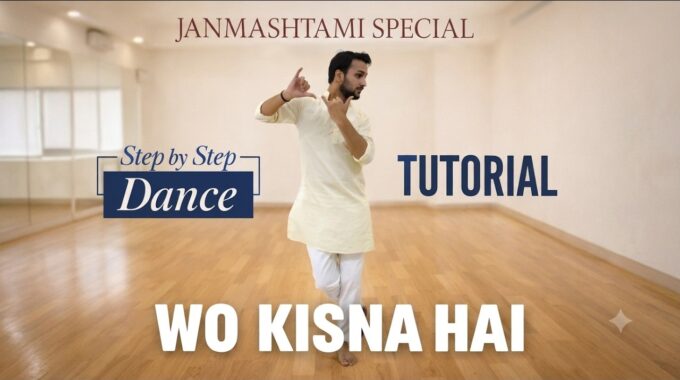
Woh Krishna Hai Dance Tutorial: Easy Janmashtami Dance Steps for Kids, Boys, Girls & Gen-Z
Looking for an easy Janmashtami dance for kids in school, a solo Krishna performance, or a fresh Janmashtami dance choreography for Gen-Z? This step-by-step guide to the Woh Krishna Hai dance tutorial is designed to help beginners learn the choreography confidently and perform it on stage.
The choreography is taught by Vishal Sharma, choreographer and instructor at Indian Dance World, with movements explained in a mirror-friendly format so learners can follow the right and left sides more easily.
Whether you are preparing for a Janmashtami dance for kids, school cultural program, solo performance, boys’ dance, girls’ dance, or a modern Krishna-themed performance, these steps can be practiced progressively and adapted to different age groups.
Note: This guide explains the choreography and practice approach based on the provided tutorial transcript. Learners should use the original video alongside this article for visual reference, timing and movement details.
Quick Overview
| Detail | Information |
|---|---|
| Dance theme | Krishna / Janmashtami |
| Dance style | Bollywood-inspired devotional choreography |
| Difficulty | Beginner to intermediate |
| Suitable for | Kids, boys, girls, teens and Gen-Z performers |
| Performance type | Solo, school stage, group or cultural event |
| Teaching format | Mirror-friendly instruction |
| Instructor | Vishal Sharma |
| Dance Studio | Indian Dance World |
| Best use | Janmashtami celebrations, school programs and cultural performances |
Why Choose a “Woh Krishna Hai” Dance for Janmashtami?
Janmashtami performances are a popular way to celebrate the birth of Lord Krishna through music, dance and cultural storytelling. A Krishna-themed choreography can combine expressive hand movements, playful footwork, turns, poses and characteristic muralī (flute) gestures to create a visually engaging performance.
The Woh Krishna Hai dance choreography used in this tutorial is particularly useful for beginners because the routine is broken into small combinations instead of requiring students to memorize the entire performance at once.
For children preparing for a school event, this approach can make the learning process easier:
- Learn one movement.
- Practice it slowly.
- Add the next movement.
- Connect the combinations.
- Practice with music.
- Add facial expressions and performance energy.
- Rehearse the complete choreography.
This progression is especially helpful when preparing a Janmashtami dance for kids in school.
Woh Krishna Hai Dance Tutorial: What You Will Learn
The choreography includes several recurring movement concepts:
- Body turns
- Dragging and sliding foot movements
- Toe positioning
- Hand coordination
- Arm changes
- Circular hand movements
- Side looks
- Small jumps
- Bouncy steps
- Krishna flute/murli poses
- Expressive gestures
- Direction changes
- Backward sliding movements
- Repeated lyrical combinations
- Performance-oriented poses
Because several combinations repeat with the music, students do not need to learn every section as an entirely new sequence.
The most important goal is to understand timing, direction, weight transfer and expression, rather than simply memorizing hand and foot positions.
Woh Krishna Hai Dance Steps: Step-by-Step Breakdown
Step 1: Understand the Mirror Format
Before beginning the choreography, understand the instructor’s mirror-style teaching.
When following a mirror-based dance tutorial, the instructor’s right side may appear on the opposite side of your screen. Beginners should therefore avoid changing sides randomly.
First identify:
- Your right hand
- Your left hand
- Your right foot
- Your left foot
Then follow the instructor’s movements as demonstrated.
This is particularly important for children because mixing up right and left sides can make an otherwise simple combination difficult.
Step 2: Start With the Body Turn
The opening movement begins with a body turn.
The basic idea is:
- Turn the body toward the back.
- Bring the right foot forward.
- Drag the right foot while coordinating the right hand.
- Position the opposite foot on the toe.
- Maintain balance.
- Follow the counting before moving into the next combination.
For beginners, don’t try to perform this at full speed immediately.
Practice the body position first.
Then practice:
Turn → drag → toe position → count
Once the feet feel comfortable, add the arms.
Step 3: Practice the Four-Count Foot Combination
The choreography then introduces an outward foot movement followed by a four-count sequence.
A useful practice method is:
1 – 2 – 3 – 4
Focus on maintaining an even rhythm.
Don’t rush the first two counts and then try to catch up on counts three and four.
For a Janmashtami dance for kids easy routine, consistent timing is more important than making every movement extremely large.
Step 4: Coordinate the Hands and Feet
One of the important elements of the Woh Krishna Hai dance steps is coordination between opposite hand and foot movements.
The choreography uses combinations involving:
- Right hand up
- Left hand down
- Foot movement
- Change of sides
- Left hand up
- Right hand down
Children should first practice the arms separately.
Practice drill
Stand in one place and repeat:
Right hand up → left hand down → change → left hand up → right hand down
After the arms become comfortable, add the feet.
This technique is useful when teaching Janmashtami dance for kids in school, because a teacher can divide the class into smaller practice groups.
Step 5: Add the Rolling Hand Movement
The next section introduces a rolling movement with the right hand.
The hand travels from the lower position and creates a circular motion before the dancer moves forward.
Think of the movement as:
Roll → circle → travel forward
The circular action should look smooth rather than mechanical.
A common beginner mistake is making the circle only with the wrist. Try to make the movement look connected through the arm while keeping the shoulder relaxed.
Step 6: Create the Krishna Flute Pose
One of the recognizable features of a Krishna Janmashtami dance for kids is the flute or murli gesture.
In the choreography, both hands are brought into a flute-playing position.
The pose can be made more expressive by:
- Turning the head slightly
- Looking toward the side
- Keeping the elbows naturally lifted
- Maintaining a relaxed upper body
- Adding a gentle facial expression
For younger children, the flute pose can become an anchor point in the choreography.
Whenever they reach this pose, they know they have completed one movement phrase and can prepare for the next one.
Step 7: Use Side Looks and Expressions
Dance is not only about footwork.
For a Krishna-themed performance, expressions and eye direction can make a significant difference.
The tutorial incorporates side looks during the choreography.
Instead of moving only the eyes, coordinate:
Head → eyes → body direction
The movement should appear intentional.
For children performing on a school stage, encourage them to look toward the audience rather than constantly looking at their feet.
Step 8: Learn the Forward Two-Step Combination
The choreography then moves into a two-step traveling sequence.
The basic idea is:
Right → left → travel forward
The right foot leads while the other foot supports the movement.
Practice this without music first.
Beginner practice
- Count slowly.
- Keep your shoulders relaxed.
- Keep your steps small.
- Maintain your balance.
- Add the hand movement after the feet are comfortable.
For a Janmashtami dance for kids solo, keeping the movement controlled is better than taking excessively large steps.
Step 9: Add the Small Circular Movement
After the forward combination, the choreography includes a small circular movement.
This can be practiced independently.
Stand in place and rehearse:
Step → circle → flute pose
The transition should be continuous.
Avoid stopping completely between movements unless the music requires a pause.
Step 10: Practice the Bouncy Step
A later part of the choreography introduces a light bounce or lift as the dancer moves.
The bounce should not become a heavy jump.
Instead:
- Place the foot.
- Slightly lift through the body.
- Transfer weight.
- Move into the next step.
For children, this movement should be performed comfortably. The goal is rhythm and energy, not jumping as high as possible.
Step 11: Return to the Back Position
The choreography uses direction changes, including returning toward the back.
This is where spatial awareness becomes important.
Before practicing with music, identify:
- Front
- Back
- Right
- Left
- Center position
For school performances, teachers can mark approximate positions on the floor so students know where they should finish each combination.
This is particularly useful when turning a Janmashtami dance for kids solo into a group choreography.
Step 12: Learn the “Albela” Section
The choreography then moves into another lyrical phrase featuring hand gestures and directional movements.
Rather than memorizing the words alone, associate each phrase with a physical action.
For example:
Gesture → step → circle → expression
The use of recognizable gestures makes the routine easier to remember.
Students can create mental cues for each section:
- Flute
- Circle
- Side look
- Step
- Hand gesture
- Turn
These cues can significantly improve memory during stage performance.
Step 13: Add the “Jiski Deewani” Movement
The next combination uses a forward step with both hands coordinated around the lyrical phrase.
The choreography then incorporates a circular movement.
When practicing this section, focus on keeping the hands and feet synchronized.
Recommended practice sequence
Hands only → feet only → hands + feet → music
This four-stage approach is suitable for beginners and young dancers.
Step 14: Learn the “Brij Ki Bala” Section
The choreography introduces another expressive section associated with the phrase “Brij Ki Bala.”
The movement uses a hand gesture traveling from one side to the other.
After the hand movement, the choreography transitions into a backward circular movement.
This section can be performed with more expression because the dancer has already established the rhythm.
For girls, boys and older children, the same basic choreography can be performed with different levels of styling and expression.
Step 15: Master the “Woh Krishna Hai” Backward Slide
One of the key visual sections of the routine is the backward sliding combination.
The choreography uses the right foot followed by the left foot while the hands move in coordination.
The sequence can be practiced as:
Right → left → right → left
The important point is that the hands change with the corresponding side of the feet.
If the right foot moves, coordinate toward the right.
When the left foot moves, shift toward the left.
This creates the visual effect of traveling backward while maintaining a connected upper-body movement.
Step 16: Practice the Repeated “Woh Krishna Hai” Phrase
The phrase repeats later in the choreography.
This is beneficial because repetition gives performers another opportunity to improve their timing.
Instead of treating the repeated section as new choreography, think of it as a chance to perform the same movement with greater confidence.
On the second repetition, dancers can focus more on:
- Facial expressions
- Eye contact
- Body posture
- Energy
- Clean hand positions
- Stage presence
Janmashtami Dance for Kids: How to Make It Easy
For younger children, the complete choreography can initially feel complicated.
The solution is not necessarily to remove every movement. Instead, break the choreography into manageable sections.
Beginner-friendly learning structure
Day 1: Opening steps + basic footwork
Day 2: Hand coordination
Day 3: Flute/murli gestures
Day 4: Turns and circles
Day 5: Forward and backward movement
Day 6: Full choreography slowly
Day 7: Music practice and expressions
This type of progressive learning can work well for a Janmashtami dance for kids easy performance.
Janmashtami Dance for Kids in School
School performances have different requirements from casual dance practice.
Students need to think about:
- Stage size
- Number of performers
- Entry and exit
- Spacing
- Costumes
- Music duration
- Audience visibility
- Synchronization
- Expressions
For a solo performer, stage movement can make the performance more engaging.
Instead of staying in one position, the dancer can gradually travel forward, sideways or backward according to the choreography and available stage space.
For a group, the same steps can be arranged into lines, diagonals, semicircles or formations.
Janmashtami Dance for Kids Solo
A solo performance gives the dancer more freedom to use expressions and stage space.
If you are preparing a Janmashtami dance for kids solo, concentrate on three things:
1. Clean movements
Every step should be understandable.
2. Expressions
Krishna-themed choreography benefits from playful, joyful and expressive performance qualities.
3. Stage presence
Don’t keep looking down at your feet.
Practice looking toward different areas of the audience while maintaining your choreography.
A simple routine performed confidently can often look stronger than a difficult routine performed without control.
Janmashtami Dance for Boys
Krishna-themed performances are equally suitable for boys.
For a Janmashtami dance for boys, the choreography can emphasize:
- Stronger footwork
- Clear poses
- Confident body lines
- Playful Krishna expressions
- Controlled turns
- Flute gestures
- Rhythmic movements
Costume and styling can also reinforce the Krishna theme without making the choreography overly complicated.
A simple Krishna-inspired costume may include traditional elements such as a dhoti-style outfit, flute and peacock-feather-inspired headpiece, depending on the school’s costume guidelines.
Janmashtami Dance for Girls
Girls can also perform the same choreography as a solo or group routine.
For a Janmashtami dance for girls, performers can focus on:
- Graceful hand movements
- Facial expressions
- Controlled turns
- Clean footwork
- Elegant poses
- Flute gestures
- Smooth transitions
The choreography does not have to be dramatically changed according to gender. The same foundational movements can be styled according to the dancer’s age, comfort and performance personality.
Janmashtami Dance for Gen-Z: Give the Performance a Modern Feel
A Janmashtami dance for Gen-Z can combine traditional Krishna symbolism with contemporary performance energy.
The goal should not be to remove the cultural identity of the performance. Instead, modernize the presentation.
Some ideas include:
- Faster transitions
- Contemporary formations
- Clean visual poses
- More dynamic stage movement
- Short synchronized sections
- Controlled freestyle moments
- Modern costume styling within cultural boundaries
- Stronger use of expressions
- Social-media-friendly performance moments
The Krishna flute pose, circular movements and expressive gestures can become visual highlights within a modern choreography.
Janmashtami Dance Choreography for Groups
If you are teaching this choreography to multiple students, divide the class into sections.
Formation idea 1: Straight line
Good for school assemblies and narrow stages.
Formation idea 2: V formation
Useful when several dancers need to remain visible.
Formation idea 3: Semi-circle
Works well for Krishna-themed performances because the central dancer can become the visual focus.
Formation idea 4: Two groups
Two groups can perform alternating sections before coming together during the repeated “Woh Krishna Hai” section.
The exact formation should always depend on the number of dancers and the available stage space.
Common Mistakes When Learning Woh Krishna Hai Dance Steps
Mistake 1: Learning too fast
Trying to learn the entire routine immediately can create confusion.
Solution: Learn one combination at a time.
Mistake 2: Ignoring foot placement
Many beginners concentrate only on their hands.
Solution: Practice feet separately before adding arms.
Mistake 3: Forgetting the mirror direction
Right and left can become confusing in video tutorials.
Solution: Confirm your right and left before starting.
Mistake 4: Looking at the floor
This reduces stage presence.
Solution: Practice the steps until you can perform them without continuously watching your feet.
Mistake 5: No expression
A technically correct dance can still look flat without expressions.
Solution: Add facial expressions after learning the choreography.
Mistake 6: Making every movement too large
Big movements are not automatically better.
Solution: Match movement size to your age, body control and stage size.
How to Practice This Krishna Janmashtami Dance
A simple practice routine can make learning much easier.
Step 1: Watch the complete tutorial
Watch the choreography once without trying to dance.
Step 2: Identify sections
Break the routine into short combinations.
Step 3: Practice slowly
Use counts instead of music initially.
Step 4: Add hands
Once the feet are comfortable, coordinate the upper body.
Step 5: Practice with music
Start at a slower speed if necessary.
Step 6: Add expressions
Use the Krishna-inspired gestures and facial expressions.
Step 7: Record yourself
Recording practice can help identify timing and posture issues.
Step 8: Perform the full routine
Once individual sections are comfortable, connect everything.
Tips for Parents and Teachers Teaching Janmashtami Dance to Kids
If you are teaching children, avoid expecting perfection during the first few sessions.
Children learn choreography at different speeds.
A better approach is to:
- Demonstrate slowly.
- Use simple counting.
- Repeat difficult movements.
- Give children visual cues.
- Practice in small groups.
- Encourage expressions.
- Give short breaks.
- Avoid overwhelming beginners with too many corrections at once.
For younger dancers, celebrate progress in individual combinations rather than judging the complete routine immediately.
Also Learn: Bum Bum Bole for Kids
How to Make a School Janmashtami Performance More Engaging
A good stage performance is about more than choreography.
Consider combining:
Music + costume + formation + expression + stage movement
For example, dancers can begin in a Krishna-inspired pose before gradually moving into the choreography.
During the repeated hook section, the entire group can synchronize their movements for a stronger visual impact.
The ending can also be designed as a final Krishna pose so that the audience clearly understands when the performance has finished.
Who Can Learn This Dance?
The choreography can be adapted for:
- Children
- School students
- Beginners
- Boys
- Girls
- Teenagers
- Gen-Z performers
- Solo dancers
- Small groups
- School cultural teams
- Janmashtami event performers
The difficulty can be adjusted by changing movement size, speed, formations and the number of combinations included.
Frequently Asked Questions
Is Woh Krishna Hai dance suitable for beginners?
Yes. The choreography can be learned progressively by breaking the routine into short combinations and practicing the footwork, hands and expressions separately.
Is this a good Janmashtami dance for kids in school?
Yes. The Krishna theme and repeatable movement combinations make it suitable for school cultural programs, subject to the school’s event requirements and available stage space.
Can children perform this dance solo?
Yes. A child can perform the choreography as a solo by focusing on expressions, clean movements and stage presence.
Can boys perform the Woh Krishna Hai dance?
Absolutely. Krishna-themed choreography is suitable for boys and can be styled with confident footwork, expressive gestures and traditional Krishna-inspired presentation.
Can girls perform this Janmashtami dance?
Yes. Girls can perform the same choreography as a solo or group routine, with emphasis on graceful movements and expressions.
Is this suitable for a Gen-Z Janmashtami performance?
Yes. The basic Krishna-themed movements can be presented with contemporary formations, energetic transitions and modern stage styling while retaining the cultural theme.
What should beginners learn first?
Start with the basic footwork and counting. Then add hand movements, turns, flute gestures, expressions and finally the complete music sequence.
How can I remember the Woh Krishna Hai dance steps?
Use musical and visual cues. For example, associate different sections with movements such as the flute pose, circle, side look, forward step and backward slide.
Do I need classical dance training?
No. The tutorial is structured around accessible choreography rather than requiring extensive classical dance training. Beginners can learn the combinations through repetition and practice.
How long does it take to learn the choreography?
The learning time varies according to age, previous dance experience and practice consistency. Beginners should focus on mastering one section at a time rather than trying to learn everything in one session.
Learn More Janmashtami Dance Choreography With Indian Dance World
If you are searching for Woh Krishna Hai dance tutorial, Woh Krishna Hai dance steps, Janmashtami dance for kids, Krishna Janmashtami dance for kids, or an easy dance routine for a school performance, this choreography provides a practical starting point.
The tutorial is presented by Vishal Sharma, choreographer and instructor at Indian Dance World, with the movements demonstrated in a mirror-friendly teaching format.
Indian Dance World focuses on making dance learning accessible for students and beginners through structured choreography and step-by-step instruction.
Want to Learn the Choreography?
Practice along with the original Woh Krishna Hai dance tutorial, repeat each section several times, and only move to the next combination after you feel comfortable with the previous one.
If you perform this choreography for Janmashtami, recording your performance can also help you evaluate timing, expressions, posture and synchronization.
For dance classes, choreography or further information, contact Indian Dance World:
📞 +91-8285199212
Instructor & Choreographer: Vishal Sharma
Studio: Indian Dance World
Final Takeaway
The Woh Krishna Hai dance tutorial can be a fun and engaging choice for a Janmashtami dance for kids, school cultural program, solo performance or Gen-Z celebration.
The key is to avoid trying to master the choreography all at once. Start with the basic steps, understand the right and left directions, practice the footwork, add the hand movements, learn the Krishna flute gestures, and then combine everything with the music.
Most importantly, dance with confidence and expression. A Janmashtami performance is not only about remembering the steps—it is about communicating the joy, playfulness and spirit of the Krishna theme through movement.
Practice the steps, add your own expression, and make your Janmashtami performance memorable.
Keywords naturally covered: Woh Krishna Hai dance tutorial, Janmashtami dance for kids in school, Janmashtami dance for kids solo, Janmashtami dance for kids easy, Krishna Janmashtami dance for kids, Wo Krishna Hai dance for kids, Woh Krishna Hai dance steps, Woh Kisna Hai dance, Janmashtami dance for kids, Janmashtami dance for Gen-Z, Janmashtami dance choreography, Janmashtami dance steps, Janmashtami dance for boys, Janmashtami dance for girls.

Related Posts